

Releasing this August we have a fascinating account of a tragic Everest expedition and a wonderful biography of Hannah Arendt. Enjoy 5 New Non Fiction Books Aug 2026!
This post may contain affiliate links that earn us a commission at no extra cost to you.
5 New Non Fiction Books Aug 2026
The Rise and Fall of the Artificial State by Jill Lepore
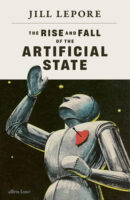
We live in the age of data. Over the past century, rapidly evolving technologies have transformed every aspect of our society, in troubling and seemingly unstoppable ways. Political campaigns have been reduced to attention-mining algorithms, multinational corporations control public discourse, and the era of the liberal nation-state seems to be coming to an end, replaced by the rule of artificial intelligence. Today, power is maintained through mystification: machines, we are told, know what humans cannot. Yet nothing about any of this was, or is, inevitable.
In this astounding account of how technology has corroded democracy around the world, prizewinning historian Jill Lepore traces the rise and fall of what she calls the ‘Artificial State’. Examining everything from robot rights and Elon Musk’s origins to what data centres cost wildlife, Lepore offers a history – and a perspective – wholly missing from the debate.
History, Lepore demonstrates, is driven not by machines but by individuals, societies, cultures and ideas. The architects of the Artificial State had no theory of governance, nor did they have any interest in the rule of law, or any capacity for restraint. They drew their ideas not from science, but from science fiction. Yet everything destructive that they have done can be undone. By illuminating the origins of the Artificial State, Lepore reveals how we can escape it – helping us to imagine, and fight for, a different future.
The Everest Mystery by Julie Summers and Jochen Hemmleb

There is no mystery more compelling than the disappearance of British mountaineer George Mallory and Sandy Irvine, last seen ‘going strong for the top’ of Mount Everest on 8 June 1924.
Mallory was a renowned climber; Irvine was a daring young sportsman embarking on the greatest adventure of his life . . . The question of exactly what happened to them on that fateful day has fascinated people for more than a century. Now, Irvine’s great-niece Julie Summers and mountaineering historian Jochen Hemmleb have written a gripping account of the 1924 expedition from Sandy’s perspective, challenging misconceptions regarding his role and the skills and knowledge of the two men.
The narrative brings to life all the remarkable characters involved in the attempt and describes the extraordinary feats of endurance and planning needed to survive the extreme conditions on Everest. The authors also examine whether the two men reached the summit – becoming the first to do so – or died on the ascent. Were their bodies seen by Chinese expeditions in 1960 and 1975? What can we learn from the discoveries of Mallory’s remains in 1999 and Sandy’s boot and foot in September 2024?
An intriguing detective story, The Everest Mystery is also a moving account of men pushing themselves to their limits in an attempt to make history.
Hannah Arendt by Thomas Meyer and Shelley Frisch

Born in Germany in 1906 to a Jewish family, Hannah Arendt became a chronicler able to translate personal experience into concise analysis; an analytical thinker who wrested from Plato, Kant, and Heidegger that which seemed eternal yet was of the utmost contemporary relevance; a free spirit who felt an obligation only to her friends, her lovers, and the truth. Arendt’s mode of thinking and the sheer range of her interlocutors and influences form an intellectual panorama of the twentieth century that is unparalleled. For her entire life, she refused to think within boundaries — her teachers, friends, and intellectual allies included Heidegger, Bultmann, Mannheim, Brecht, and Benjamin, to name but a few.
Drawing on newly discovered archival materials and previously overlooked documents in both Germany and the USA, Thomas Meyer traces Arendt’s journey from Königsberg to Paris — where she fled after being imprisoned in 1933 — and finally to New York in 1941, illuminating her formative years and the development of her radical and brilliant books, as well as her famous affair and lifelong philosophical debate with Martin Heidegger, whose Nazism was a permanent challenge to her.
Woman, friend, lover, journalist, Jew, human rights activist, philosopher and political theorist, Arendt continues to exert fascination as both icon and thinker. Meyer’s biography centres on two pivotal phases: Arendt’s years in Paris after fleeing Nazi Germany, and her time in the United States leading up to the landmark publication of The Origins of Totalitarianism in 1951. It was her coverage of the trial of Adolf Eichmann in Jerusalem in 1961, however, that would make her world-famous — and notorious. Her coining of the phrase the banality of evil to describe the Nazi bureaucrat who had helped orchestrate the Holocaust remains one of the most debated and resonant formulations in modern thought, as controversial today as when she first wrote it.
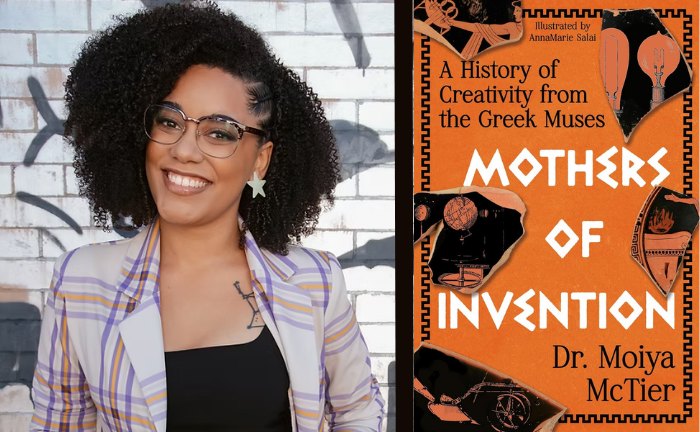
Mothers of Invention by Moiya McTier
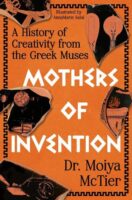
A rollicking, enlightening examination of the inspiration behind some of humanity’s most important milestones, written from the perspective of the Greek Muses. From Homer to Copernicus to Edison, the idea that a “lone genius” could be responsible for a groundbreaking masterpiece or remarkable breakthrough has pervaded historical accounts of human innovation—from Isaac Newton and gravity to Henry Ford and the assembly line.
But this myth is as false as it is harmful, putting undue pressure on fallible individual mortals and eroding the value of true creative expression. Ideas don’t just form in a vacuum—they’re inspired! If you look close enough, the influence of the powerful and (mostly) benevolent Greek Muses can be seen in each of humanity’s major inventions.
In Mothers of Invention, the Greek Muses reveal the role they played in humanity’s most important milestones—from using astronomy to make sense of the universe to harnessing of electricity to transform life on earth. In sharing their perspectives on human history, the Muses offer insights into the origins of religion, democracy, and physics, providing a more nuanced—and decidedly mythical—perspective on these monumental developments. The result is a compelling argument for looking at human history with fresh eyes—recognizing the power of collaboration and reframing what it really means when inspiration strikes.
Exhumed by Aaron Mahnke
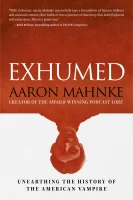
What would drive a man to exhume the body of his daughter and remove her heart? That question has haunted Aaron Mahnke, creator and host of the award-winning podcast Lore. Fueled by a decade of research, Mahnke excavates the past to understand the hysteria that fueled the ghastly exhumation of Mercy Brown in 1892, who like her mother and sister before her, succumbed to “consumption” at the age of 19.
With Exhumed, Mahnke presents a unique history of the intersection of folklore and science, and how pop culture and both genuine medical advancements and pseudoscience of the time shaped the perspectives of people in 19th century America. From the death of George Washington to Mary Shelley writing Frankenstein, Mahnke leads reads on a fascinating journey through history, touching on methods of mummification, the multifaceted role of executioners, medicine made from corpses, European folklore that traveled across the Atlantic, and so much more. He reveals that as shocking as Brown’s exhumation might seem, it also reflected surprisingly common attitudes and beliefs about the relationship between the dead and the living, the nature of science and magic, and the fate of a human soul. It all builds to a revelatory understanding of human behavior that continues to this very day.
If you enjoyed 5 New Non Fiction Books Aug 2026, check out Most Anticipated Translated Fiction 2026 Part 2 (July – Dec)